Patients ask me some version of this question at almost every implant consultation: how long do dental implants last, really? Marketing brochures say “a lifetime.” Skeptical friends say “10 years, max.” The honest answer sits in between, and it depends more on the person than on the implant. After 20+ years of placing and following implants in Huntington Beach, here’s the real-world picture.
The short version: the titanium implant post itself has a 95% success rate at 15 years and often outlasts the patient. The crown on top is the wear part — that averages 10 to 15 years before it needs replacement. The full-mouth math is very different from what you’d guess.
The Two Parts With Two Different Lifespans
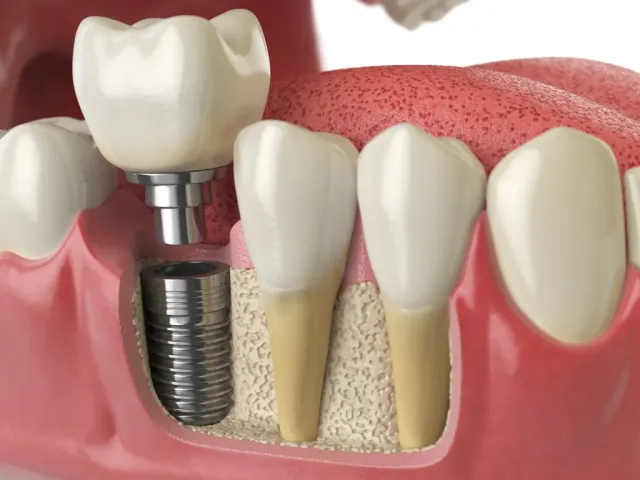
A dental implant isn’t a single piece. It’s a system with three components, and each has its own service life. Confusing them is where most of the “implants only last 10 years” misinformation comes from.
- The implant post — titanium screw fused into your jawbone. Designed to be permanent. Documented success in the same patient at 30+ years.
- The abutment — connector between post and crown. Rarely fails, but occasionally loosens and needs re-tightening.
- The crown — the visible tooth. Wears, chips, and stains just like a natural tooth. Typical replacement window: 10–15 years.
When someone says their implant “failed” after 12 years, they usually mean the crown needed replacement — which is normal maintenance, not implant failure. The post underneath is still doing its job.
If you’re weighing the upfront cost against long-term value, our dental implant cost guide for Huntington Beach walks through the real 2026 pricing so the lifespan math has real numbers behind it. Long-term success starts with the first few months, which my implant healing timeline covers week by week.
What the Research Actually Shows
- 10-year survival rate: 90–95% (across dozens of large studies)
- 15-year survival rate: ~92% for well-maintained implants
- 20-year survival rate: 82–89%
- 30-year documented cases: yes, and increasingly common
The NIH-published implant success literature puts the 10-year failure rate for modern titanium implants around 3–5% in healthy non-smokers. That’s better than most other surgical procedures we perform. The number climbs in smokers, uncontrolled diabetics, and patients with untreated gum disease — factors that are within your control.
What Actually Shortens Implant Life
In our practice, the implants that fail almost always fail for one of these reasons — and most are avoidable.
1. Peri-Implantitis (Gum Disease Around the Implant)
The single biggest cause of long-term implant failure. Bacteria colonize the gum pocket around the implant, inflame the surrounding bone, and the bone starts receding. Once you lose enough bone, the implant loses anchorage.
The catch: peri-implantitis is often painless until late. That’s why routine cleanings matter more with implants than they do with natural teeth. Watch for warning signs the way you would with natural teeth — our guide on gum disease warning signs you shouldn’t ignore walks through what to look for.
2. Smoking
Smokers experience implant failure at roughly 2x the rate of non-smokers. Nicotine constricts blood vessels in the gums, which starves the healing tissue of oxygen during osseointegration and increases infection risk long after. If you smoke and you’re considering implants, we’ll ask you to quit — at minimum during the healing window.
3. Uncontrolled Diabetes
Poorly controlled blood sugar impairs healing and increases infection risk. Well-controlled diabetics (HbA1c below ~7) have essentially the same implant success rate as non-diabetics. It’s the “uncontrolled” part that matters.
4. Bruxism (Nighttime Grinding)
Nighttime grinding puts hundreds of pounds of lateral force on your teeth — and implants don’t have the natural shock-absorption that periodontal ligaments give real teeth. Grinding can crack crowns, loosen abutment screws, and micro-fracture the bone-to-implant interface over years.
Almost every long-term implant patient at Peninsula Dentistry wears a custom nightguard. If you grind, read our overview of how a custom nightguard can save your smile — the same protection applies once you have implants.
5. Poor Placement or Cheap Materials
Implants placed without a cone-beam CT scan, at incorrect angles, or with off-brand components fail earlier and more often. The materials matter. At Peninsula Dentistry we use only major-brand titanium systems (Straumann, Nobel Biocare) and zirconia crowns because the data on their long-term performance is well-established.
The Care Routine That Keeps Implants for Life
Here’s what I tell every patient the day their final crown is placed:
- Brush twice daily with a soft-bristle toothbrush. Electric brushes with pressure sensors help protect gum tissue around implants.
- Floss daily, or use a water flosser + interdental brush for the implant sites. Bacteria at the gum line is the enemy.
- Come in every 6 months for cleaning and imaging. Implants need imaging on a 1–3 year rotation to catch early bone loss.
- Wear your nightguard if you grind. Non-negotiable.
- Skip the popcorn kernels and hard candy. Cracked crowns are the top preventable maintenance issue.
- Quit tobacco. Full stop.
That routine is what separates 30-year implants from 12-year implants. The implants themselves don’t fail on a schedule — the environment around them does.
When Implants Do Need Maintenance
Even with perfect care, some maintenance is normal across an implant’s life:
- Crown replacement: every 10–15 years for cosmetic wear, chipping, or shade mismatch after adjacent teeth age
- Abutment screw tightening: occasionally over decades
- Deep peri-implant cleanings: if pocket depths increase, we do a specialized implant scaling to remove bacterial colonies
- Bone grafting: rarely, if peri-implantitis is caught late
Total cost of ownership over 30 years is usually one crown replacement, one or two abutment adjustments, and routine cleanings. That’s dramatically less than the cost of replacing bridges or dentures 3–4 times over the same period.
Are Implants Right for Everyone?
Not always. Patients who benefit most:
- Healthy non-smokers
- Diabetics with controlled blood sugar
- Adequate jawbone (or willingness to accept bone grafting)
- Good oral hygiene habits
- Committed to routine cleanings
Patients who might do better with alternatives:
- Heavy smokers unwilling to quit
- Severe uncontrolled bruxism (implants can be done, but with extensive planning)
- Certain autoimmune conditions or ongoing bisphosphonate therapy
- Patients who can’t commit to twice-yearly cleanings
If any of that describes you, dentures vs. dental implants comparison walks through the trade-offs.
The Peninsula Dentistry Approach
Every implant I’ve placed in the last 20+ years starts with a cone-beam CT scan, uses major-brand titanium implants and zirconia crowns, and includes a formal 6-month recall schedule. That’s not a marketing pitch — it’s the recipe for the 25-year success cases we still see in our chairs.
If you’re considering implants or you already have them and want a second opinion on maintenance, book a consultation. Schedule a dental implant evaluation at our Huntington Beach office, or explore the full dental implants service page for what treatment looks like.
FAQ
How long do dental implants last on average? The titanium implant post has a 90–95% survival rate at 10 years and often lasts 20–30+ years. The crown on top typically lasts 10–15 years before it needs replacement. Well-maintained implants in healthy non-smokers frequently last a lifetime.
Do dental implants ever need to be replaced? The implant post rarely needs replacement — it fuses to your bone and becomes permanent. The crown on top wears like a natural tooth and typically needs replacement every 10–15 years. Abutment screws may need periodic re-tightening.
What causes dental implants to fail? The top causes are peri-implantitis (gum disease around the implant), smoking, uncontrolled diabetes, bruxism without a nightguard, and poor placement. Most failures are preventable with routine cleanings and good hygiene.
Are dental implants worth it long term? For most healthy patients, yes. Total 30-year cost of ownership is usually one crown replacement and routine cleanings — dramatically less than replacing bridges or dentures 3–4 times over the same period.
Do implants require special cleaning? Yes. Standard brushing and flossing, plus water flossers and interdental brushes for gum-line access. Professional cleanings every 6 months and X-rays every 1–3 years catch early bone changes before they become failures.
Can dental implants get cavities? The implant itself cannot decay. However, the adjacent natural teeth can, and the gum tissue around the implant can develop peri-implantitis. That’s why oral hygiene doesn’t relax after implant placement.
Dr. Kenneth Tran, DDS, is the founder of Peninsula Dentistry & Orthodontics in Huntington Beach. NYU College of Dentistry, Class of 2001. Over 20 years placing and maintaining dental implants across Orange County.